Category Guide
Match symbols and photos to current buylist categories. These buying groups are not a complete list of official Pokémon rarities.
Before you sort
English, authentic, Near-Mint cards only; remove individual sleeves. Separate categories and count each card once. Ship only after quote approval and shipping instructions.
Common/Uncommon
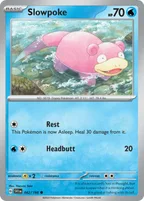
Non-foil common and uncommon Pokémon and Trainer cards.
- Look near the bottom of the card for a black circle (Common) or diamond (Uncommon). Symbol position varies by set.
- Use this group for non-foil common and uncommon Pokémon and Trainer cards. A rarity symbol alone does not identify the foil finish: tilt the card under light.
- Keep foil cards and Basic Energy separate. A non-holo card with a rare star is not a common or uncommon; do not add it to this group.
- The printed circle identifies this common card. Check its finish before counting it with non-foil bulk.
Holo/Reverse

Reverse-holo and other ordinary foil bulk, separate from Holo Rare.
- A reverse-holo usually has reflective foil around the illustration, across the text/background area, while the illustration itself is usually non-foil. Patterns vary by set.
- Reverse-holo cards can have a circle, diamond or rare star. The star does not make a reverse-holo the same as a traditional Holo Rare.
- Keep Holo Rare cards with foil artwork in their own group, and separate EX/V/GX and VMAX/VSTAR. For an unusual foil treatment, ask staff to confirm the correct group before counting.
- Tilt the card to inspect where the foil appears; a photograph or rarity symbol alone may not show the finish.
Holo Rare
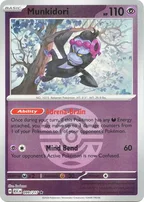
Traditional rare cards with holographic artwork.
- Look for a rare star and reflective foil in the illustration. Older sets often have yellow borders; Scarlet & Violet rare cards can also have foil on their silver borders.
- Check the actual card under light. Foil patterns and borders vary by set; a star on a non-foil card does not make it Holo Rare.
- Count Holo Rare separately from reverse-holo bulk. Pokémon EX, GX, V, ex, VMAX and VSTAR belong to their designated buying groups, not here just because they are shiny.
- Inspect the illustration for holographic foil and confirm the rare designation, rather than relying on the border alone.
EX/V/GX
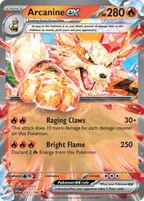

Double Rares, Ultra Rares, Pokémon ex, V, EX, and GX cards.
- Look for EX, GX, V or lowercase ex printed with the Pokémon name. These designations span different eras and do not all share one rarity symbol.
- In Scarlet & Violet, Double Rare uses two black stars for regular Pokémon ex. Ultra Rare uses two foil/silver stars for full-art Pokémon ex and some Supporters; the two-black-star illustration shown here means Double Rare specifically.
- Texture is not universal: regular versions may be smooth, while some full-art and Tera treatments are textured. Do not classify a card by texture alone.
- Keep VMAX/VSTAR separate. A Trainer with Ultra Rare stars is not automatically EX/V/GX; ask staff about cards that do not match the Pokémon designations before including them.
- Check the Pokémon designation and printed rarity. This example represents the buying group, not every possible rarity treatment.
VMAX/VSTAR
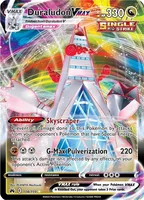
Pokémon marked VMAX or VSTAR, counted separately from ordinary V.
- Look for VMAX or VSTAR printed with the Pokémon name and in the card's designation. Do not group these with an ordinary Pokémon V just because the name contains V.
- VMAX cards typically show a Dynamax/Gigantamax Pokémon; VSTAR cards carry a VSTAR Power. Use the printed designation, not artwork size or texture alone.
- Keep all matching VMAX and VSTAR cards in this group and count each once. Consider checking individual card values before choosing to sell collectible versions at bulk rates.
- The printed VMAX/VSTAR designation, rather than a shared V or shiny finish, identifies this separate group.
Energy
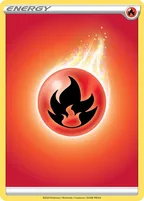
Basic Energy cards, separate from Pokémon and Trainer bulk.
- Basic Energy prominently displays an Energy-type symbol, such as Grass, Fire or Water. Newer cards explicitly say Basic Energy at the top.
- Special Energy has its own card name and effect text; newer cards say Special Energy. It is not interchangeable with Basic Energy for sorting.
- Count Basic Energy separately. Do not assume this category accepts Special Energy or every foil Energy version; ask staff to confirm ambiguous versions before including them.
- The large Energy-type symbol and Basic Energy designation distinguish this example from Special Energy.
Identification references
Use these sources for identification, not acceptance or rates. Our public buylist and approved instructions determine what to send.
View the current buylist and selling FAQs for more information.